



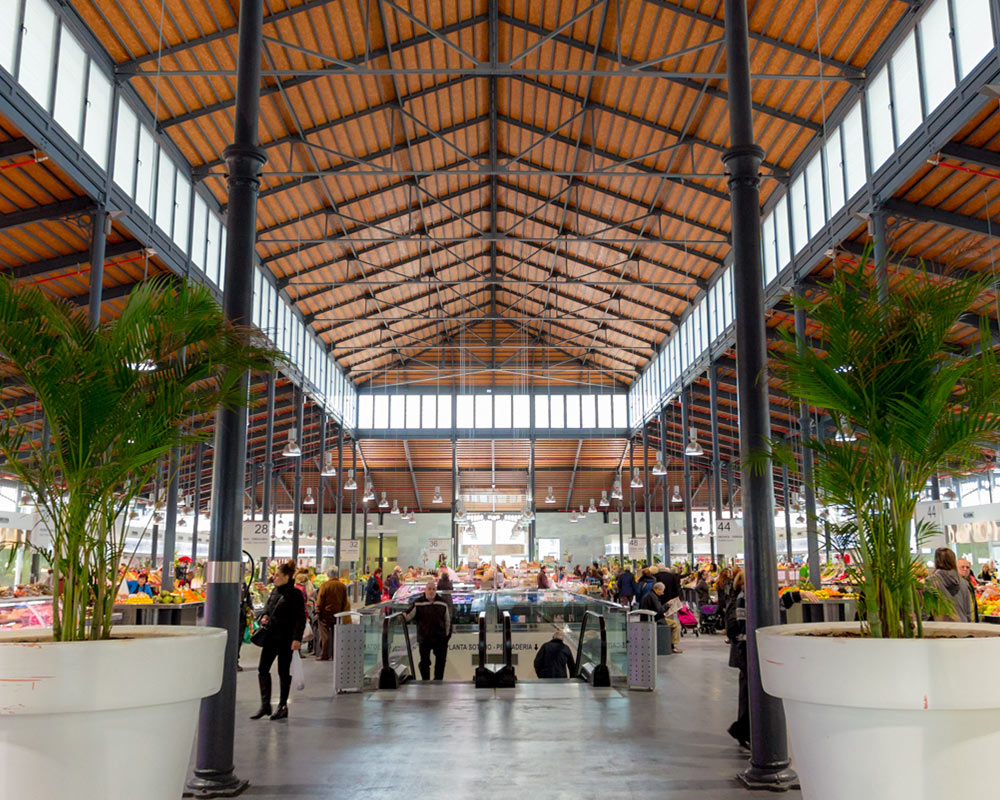
The Central Market
The project to construct a building for public market in Almería is old, initially being thought in the construction of a market in the center of the old town, thus protecting which was celebrated in the Plaza of the Constitution at the beginning of the decade 1840.
The appearance in the second half of the nineteenth of a bourgeois expansion to the east of the city, cornered build projects in the old town, prospering the idea of placing it in the area of residence of the local bourgeoisie.
Thus, in the extension of Paseo project, designed by architect Jose Marin Baldo in 1860, he was reserved in the center of widening lift, a plot for the construction of a public market and fishmonger. Since then, some projects do not come to fruition until the project works to Trinidad Cuartara Cassinello was awarded in 1892, succeed.
Its location was the most suitable, near the confluence of two major thoroughfares of bourgeois expansion, Bishop Street Orberá and Paseo open to it through a street that for this purpose projected (street Aguilar de Campo) at the bottom of the main facade it would stand.
The market has been preserved virtually intact to this day. In 1982 he carried out a major restoration. Construction, which is included within the Iron Architecture, became almost whole of this material, except the basement and the flag of the main facade rose with masonry factory, brick and stone. The armor covers is metallic and the closure of the facings made from blinds and windows. On the home front, the street Aguilar de Campo, is represented the symbol of abundance, a female figure with a basket of fruit.
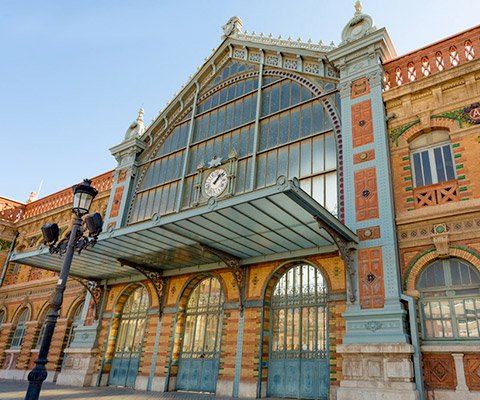
The Railway Station
The birth of the railroad in Almería is linked essentially to the extraction of iron ore from the mountains of the interior. an inexpensive transportation is needed to output the ore Alquife (Granada) and the Sierra de los Filabres (Almería) to the Port of Almería. Almería- Guadix The line will open in 1895, and the full line up Linares will be inaugurated on March 14, 1899, allowing the connection of Almería with the rest of the nation.
The old central station building is a beautiful example of Iron Architecture, characteristic of industrial and functional buildings of the second half of the nineteenth century. The iron will prevail over traditional materials (stone and brick) for consistency to support heavy loads and cover large areas. The glass closure walls and roofs, was very appropriate for light and airy constructions.
The main facade, towards the front of the station, responds to a model of pavilion three bodies, the central and principal, built with both symbolic materials of the new architecture being: iron and glass. Creating a huge stained glass window in the entrance to the building as a monumental portico, suitable to receive the almerienses who used the new medium of communication. In the lateral bodies, stone and brick, covered with glazed ceramic is used.
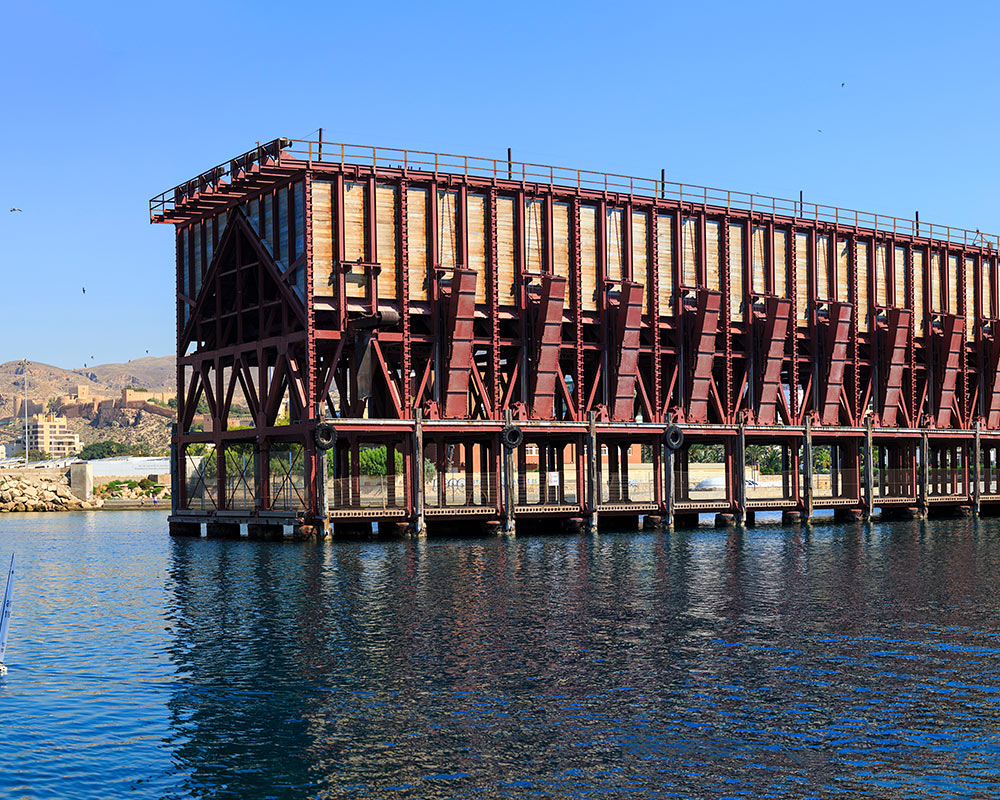
The English Cable Structure
The mineral loading, called “English Cable”, is located in the Playa de las Almadrabillas, dockside lift and the terminal of a branch of the railway. It was originally owned by British mining company “The Alquife Mines Railway Limited” (hence its name), which won the concession in 1901, immediately undertaking the construction in 1902.
It is an example and a masterpiece of iron architecture of the early twentieth century. Its construction is possible due to the construction of the port and railway, moving its construction in the current eclectic but introducing a new architectural language characterized by the use of new materials, such as iron. Its surroundings form the beach and a bridge link with the railway station.
It consists of two parts: access linking the railway station with the landing, and the pier itself through which the trains could unload directly into the hold of the ships. Your access begins at the terminal of the railway, whose middle section rests in large arches on pillars of stone, separated by metal sections based on large iron beams. In 1998 he was declared of cultural interest for its historical, symbolic and aesthetic values.
Address: Playa de las Almadrabillas, s / n. 04001 Almería.
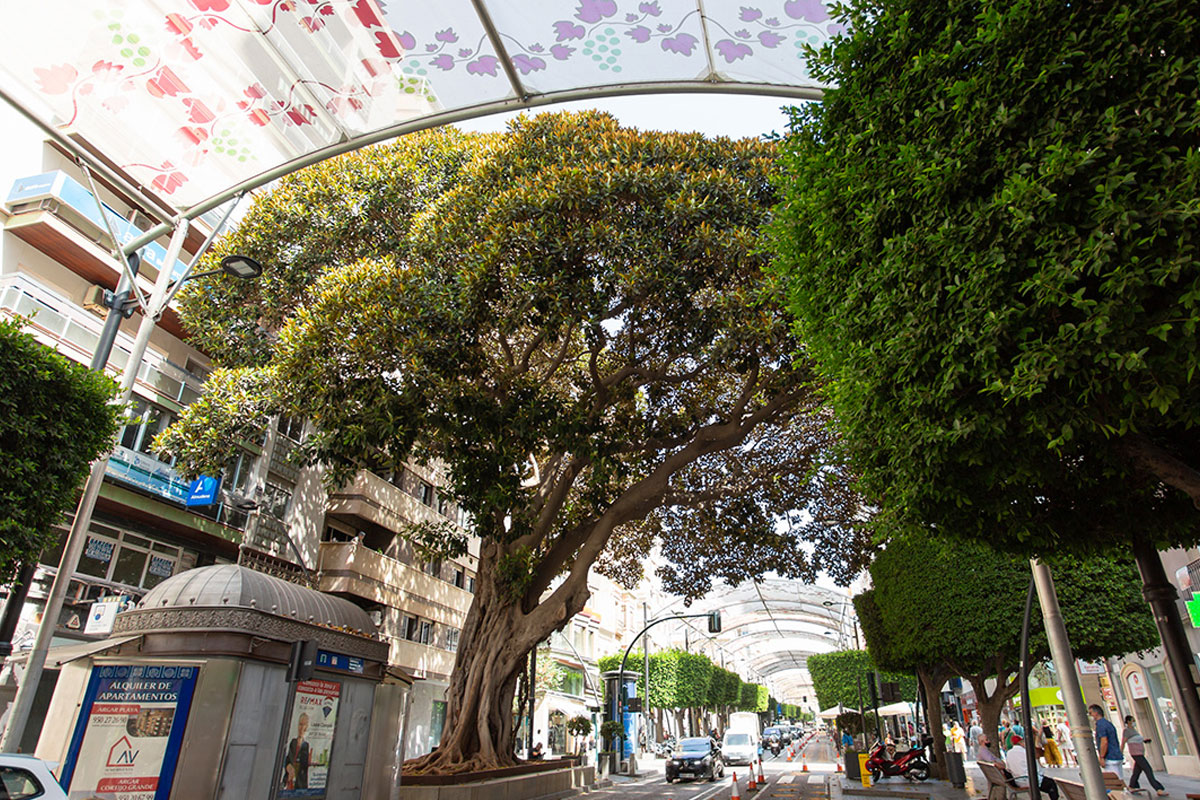
Puerta de Purchena and Paseo de Almería
All the planning of the expansion of the Puerta de Purchena and Paseo de Almería took place in the mid-nineteenth century. The Puerta de Purchena, the nerve center of the city, was located specifically at the confluence of the current Plaza del Carmen and Plaza de Manuel Perez Garcia. Former “Puerta de Pechina”, the main entrance to the city that connected with the way of Pechina. Christians mistakenly known as Puerta de Purchena. It was demolished, like most of the walls in 1855. The door, shortcut, was framed by two towers in slope at the base.
Paseo de Almeria, along with the Puerta de Purchena, is today a meeting point of Almeria facing the commercial visit, business management in cafes around, or just a morning walk space. If initially the door was a space outside the walls, it will become the occasion of urban development in the second half of the nineteenth century, centerpiece of the urban fabric.
In the bourgeois widening lift in the second half of the nineteenth century, and after the demolition of the walls, the Paseo and the Puerta de Purchena become the prime area of the city, being connected urban development of the city in this period under the mining and trade of grapes that enriches the bourgeoisie.
Along the Paseo and the Puerta de Purchena you can see examples of houses of the bourgeoisie Almeria late nineteenth century and early twentieth century. This is single family or multi-family housing, among which the “Butterfly House” in the heart of the Puerta Purchena. This house is known for “House of Rapallo” by one of its owners or “Butterflies” by the most striking decorative motif presented. It was designed by the municipal architect Trinidad Cuartara Casinello.
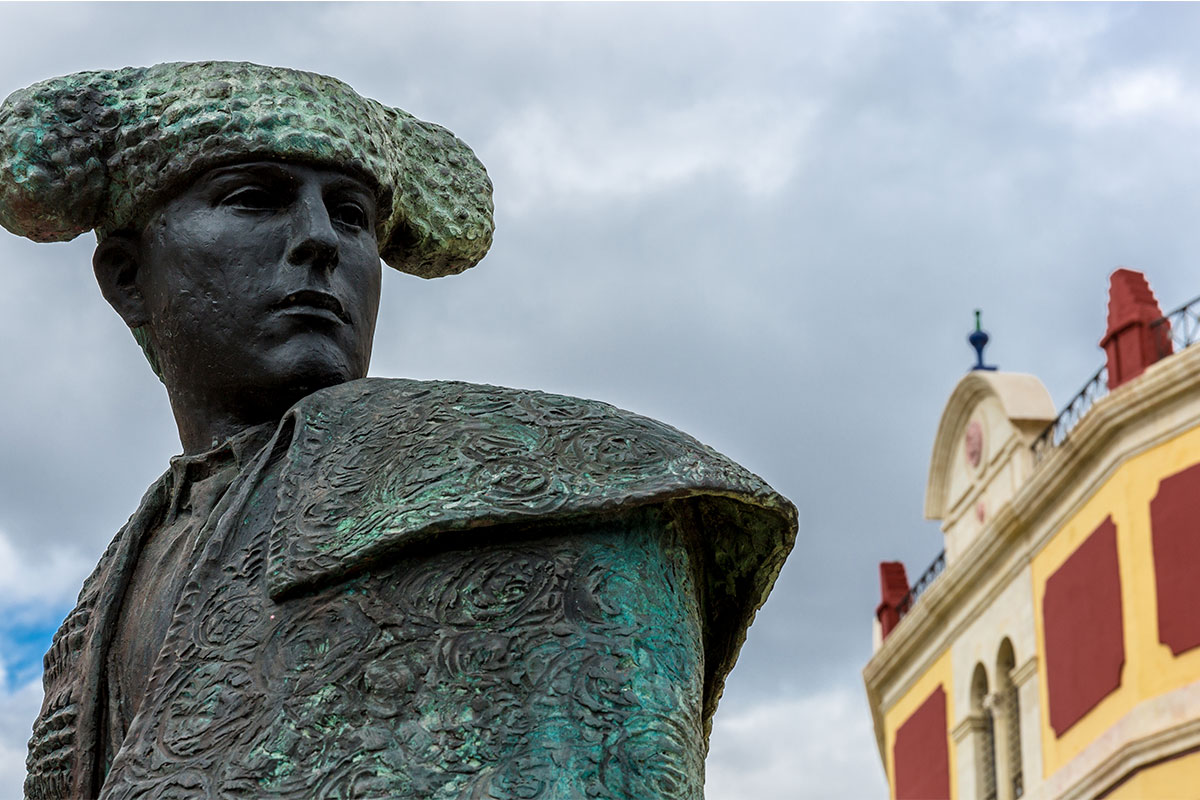
Bull Ring
The old bullring, situated between Murcia, Granada streets (where now stands the “Malecon Jardinillos”) and Circus, near the Rambla, was built in 1849. At the end of the century it became too small and uncomfortable for the needs of the local bourgeoisie, which was increasingly numerous and rich. For this reason, a joint stock company (led by the most representative of the bourgeoisie Almeria), which bought the land for the new square in the “Huerta de los Lopez” at the end of the street Calvary was organized.
The first construction stone was laid on August 13, 1887, celebrated a public ceremony attended by local authorities. The work, led by the two officers architects of the city, Enrique López Rull and Trinidad Cuartara Casinello, completed in July 1888, being the official capacity of 1,054 people Square.
The architecture of the square is eclectic. It consists of a polygonal of twenty sides, three of which are advanced in outgoing bodies, forming Monumental covers access to the entrance of the sun, the principal, and the entry of shade. At the main entrance, there on the keystone of the arch a shield showing the head of a bull with characteristic instruments of the party. In building the Arab influence is seen in the horseshoe arches on the second floor.
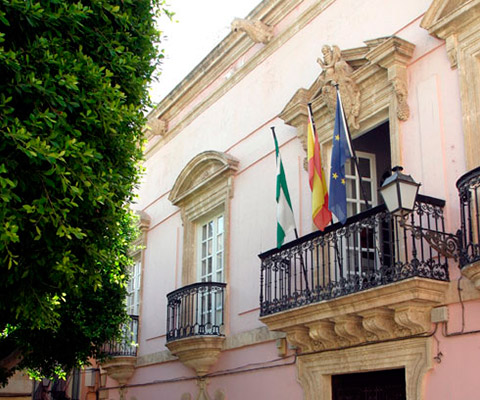
Palace of the Viscounts of Castillo de Almansa
The gradual spread of academicians ideas in Spain in the second half of the eighteenth century, will have consequences for the development of housing Almeria. The popular and Baroque features, sometimes closely linked, are to be replaced by an aesthetic intellectualism in architecture predominant feature of the historicist current.
That moment of transition is well defined on the facade of the Palace of the Viscounts of Castillo de Almansa, title created in 1773 for the Almeria family of Almansa.
The palace is one of the most important examples of domestic architecture of the city. The palatial home built between 1773 and 1780 approximately.
The facade, with entablature on top, has two floors: the bottom openings regular distribution houses, and the upper, curved balconies topped by pediments and parties, where the family crest is.
Down the street Infanta you access the Provisional Archaeological Museum, with monumental cover of the “Casa de Don Francisco Jover y Tovar”, designed by the municipal architect Cuartara Casinello Trinidad in 1894.
The whole of the Palace of the Viscounts of Castillo de Almansa, and D. Francisco Jover y Tovar, the mayor and chronicler of Almería, belonging to the current Provincial Historic Archive.
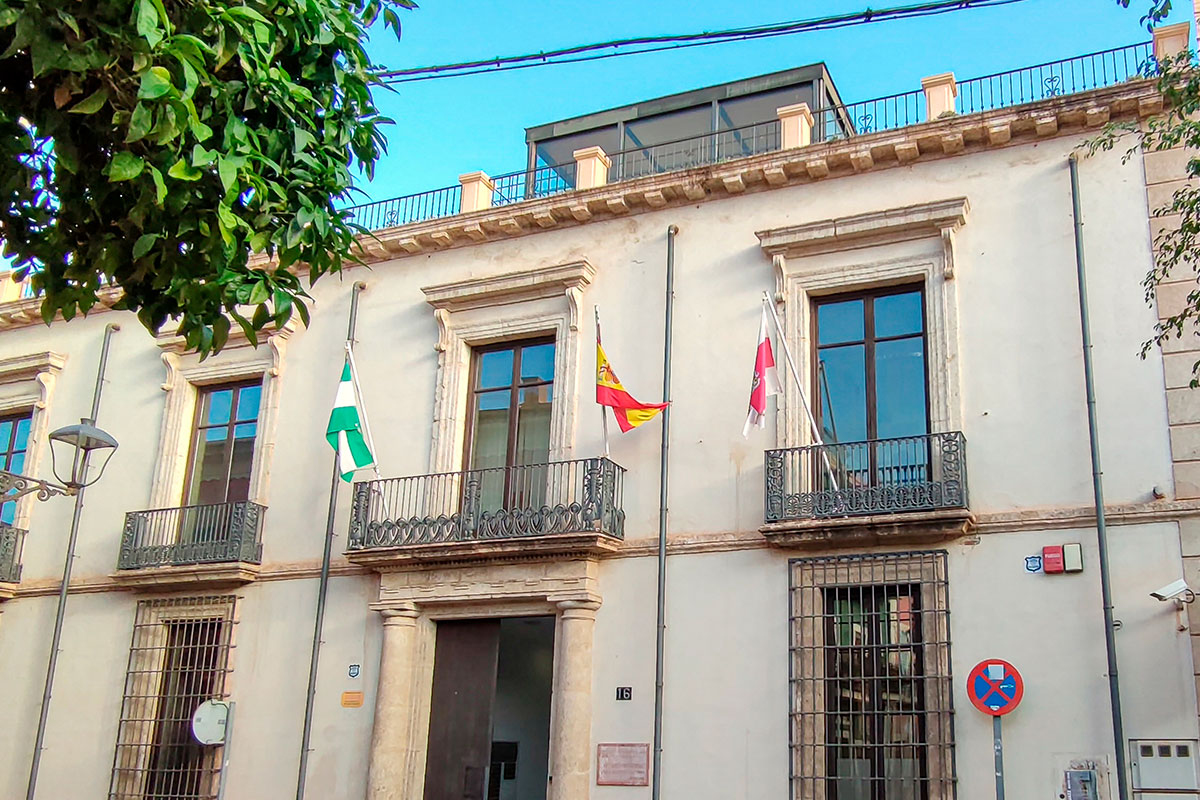
Palace of the Marquis de Cabra
Palatial house belonging to José Jover and Maria Greppi, his daughter Maria Jover Greppi, after marrying D. Martin Belda, who won the title of Marquis de Cabra, would get the title of Marquise de Cabra, therefore, the house is known as Marquis de Cabra.
The housing is located in a charming square in the historic center: the Plaza Campoamor where is the Bas Relief Valentine ( Bajorrelieve de San Valentín ) (, it is one of the best examples of palatial aristocratic homes built during the neoclassicism. It is one of the purest and most monumental classicist buildings of the mid-nineteenth century, it has been restored. It emphasizes its monumental and elegant facade, where some of its historical elements observed in its cover and half Tuscan columns. The house is divided into two floors, the ground floor revolves around a patio lights and the first floor belongs to the noble part of the building. He stands outside his artistic ironwork on the balconies. Ends the building in a simple cornice.
The building is home to the Municipal Historical Archive.

Celia Viñas Institute
The first Secondary School of Almeria was founded in 1849 at the current site of the School of Arts. This was at the time a much smaller than the current building, and this led to that, students and educational needs increase, D. Francisco Saiz Sanz, director of the center, moved to the current building Street Javier Sanz, who was the old School of Arts and Crafts.
The Institute, built in 1911, and was the site of formation of much of Almeria. In the beginning I had mixed character, until it built which became the Male Institute, Nicolas Salmeron Institute, located in Garden City in 1966.
The students enter through the access of the Rambla, they occupied the third floor and the roof used as playground and gym while the boys occupied the ground floor and the patio.
The building featured a strong cultural tradition, hosting an important library and the first Almeria Archaelogical Museum, installed in two showrooms enabled this feature. Its name comes from the memory of the unforgettable professor Celia Viñas, who was also an important poet, reviving his literary work and his teaching, Almeria postwar cultural life.
The uniqueness of the building, which is part of the historicist current neoacademicismo, is reflected in its main facade: great monumentality, with the use of very characteristic classical elements: pilasters of giant order, high base, cover large, spans large dimensions and monumental staircase to the first floor.
Address: Javier Sanz Street.
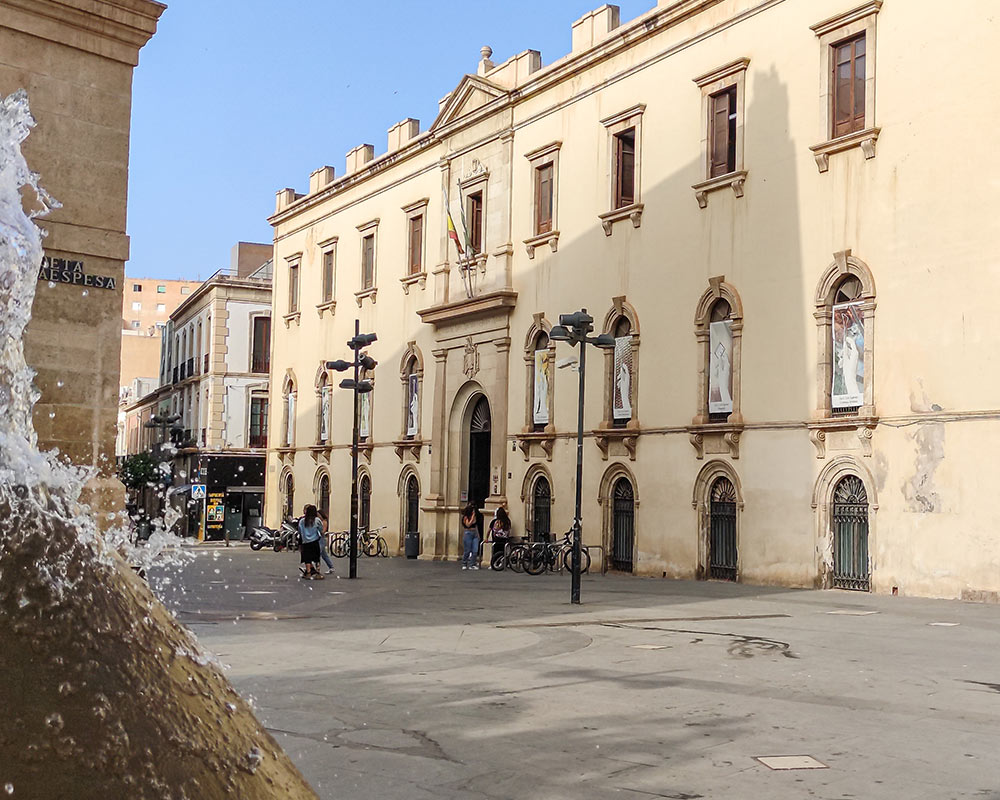
School of Arts and Crafts
The building was the Provincial Institute of Secondary Education during the second half of the nineteenth century and much of the twentieth century, being the highest educational institution in the city. It replaced the primitive College of Humanities, since 1840, worked in which was Convent of Santo Domingo. During the time that was Institute were made in it important reforms affecting internal distribution and its three facades. The located south (Calle General Tamayo) was restored in 1889 for being in ruins since 1867.
The general composition of the building calca almost strictly the College of the Pure, featuring the same design on the openings of the ground floor, splayed and columns in the jambs, countering with the completely different floor, framed by eclectic elements classicist origin.
The central courtyard of the school, belonging to the former convent of Santo Domingo, dating from the eighteenth century, and is, today, an exceptional setting of important exhibitions and cultural activities almeriense life, such as the Andalusian Center of Photography , which has its headquarters there. The cloister was restored in the eighteenth century and the third floor is newly built.
Schedule: See here.
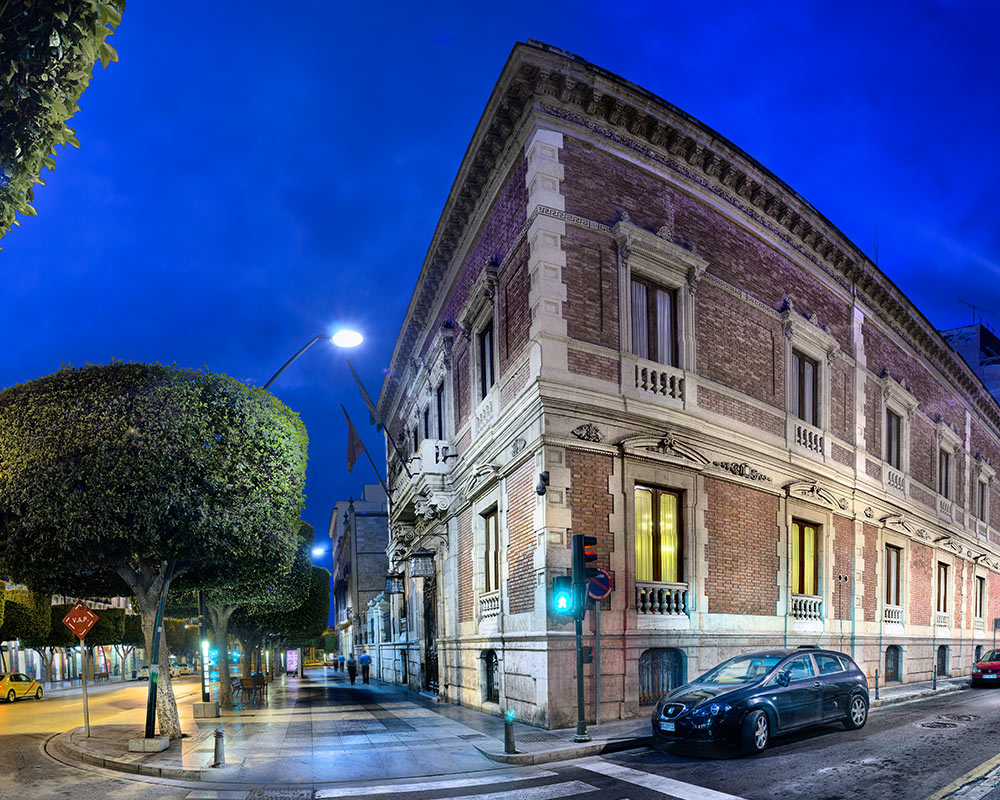
Cultural Casino
Cultural Casino is the current headquarters of the Delegation of the Interior. Originally a palatial house of the Almeria bourgeoisie of the late nineteenth century. Its structure, which follows the historicist models of the time, led to its declaration as a Historical and Artistic Monument in 1982.
The Culture Casino, founded by Joaquin de Vilches in 1840, was definitively taken to El Paseo after considering alternative possibilities. The Culture Casino was established in what was the home of Emilio Perez Ibañez, who had been an important member of the local bourgeoisie in the Restauracion (political period in which the Bourbon Family were again on the Throne 1874-1931). The Project was implemented by Enrique Lopez Rull a very important architect of the time.
Construction, which had several locations in the late nineteenth century and was founded by Joaquin Vilches in 1840, moved permanently in 1905 Paseo, which had been home of Emilio Perez Ibáñez, a leading member of the Almeria bourgeoisie of the period Restoration. It was designed in 1888 by architect Enrique López Rull, very important at the time.
In the 20s of the twentieth century made the building a series of reforms, especially in the ballroom and Muslim ladecoración the “Arab Hall”.
In the Casino had cultural events, it was also a place of social gatherings where the news of the city and related to the situation of the industries and agriculture were discussed local news. It was rather play snooker or chess.
During the Civil War undergoes a partial fire because of the bombing and general neglect. It is renovated in 1940. The building is abandoned between 1950 and 1960, after being acquired by the Government of Andalusia to face the seizure of property.
The facade of the building, which is part of the historicist current, responds to the classic bourgeois model of structure with stone base, which houses the basement, and a monumental doorway crowned with a balcony on the top with classical influences. It has a large hall intended for carriages and artistic staircase railing.
Address: Paseo de Almeria.
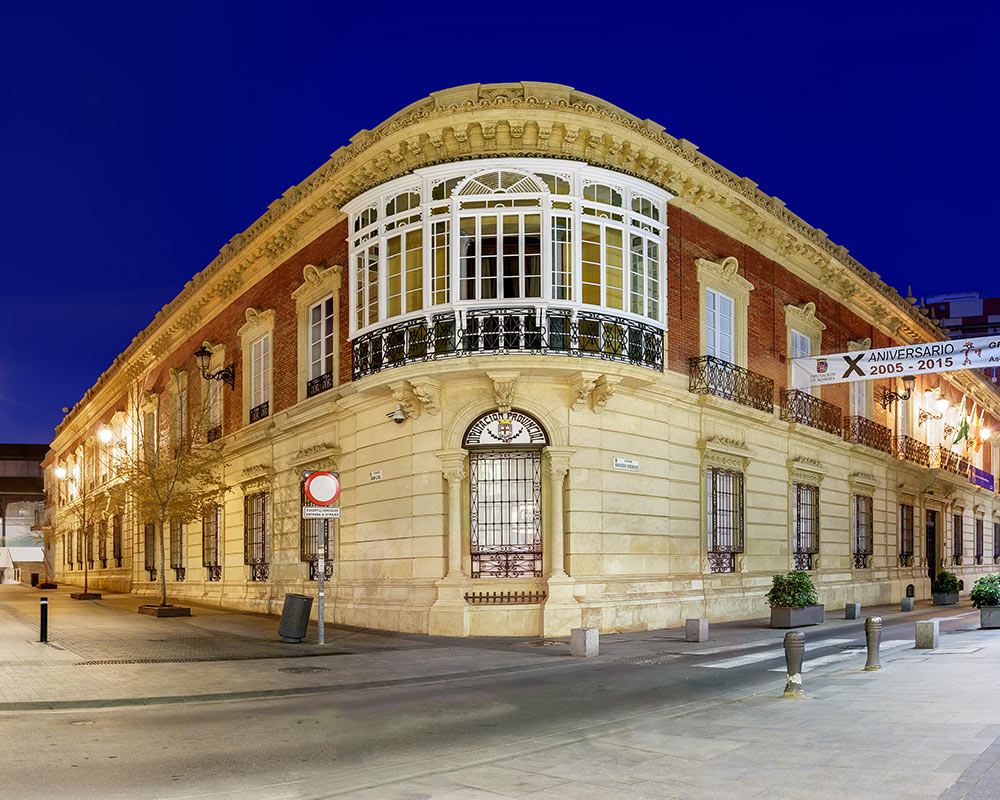
Casa Palacio de Juan Lirola (Council)
The building of the Provincial Government is a house of the bourgeoisie Almeria, known as house-urban palace, located in the former home of Don Juan Lirola, liberal politician of great influence. 1884 enlargement of the architect Trinidad Cuartara Cassinello should. The original project, 1880, occupied the corner of Catholics and Navarro Rodrigo Reyes.
The building, of great importance, consists of two floors. In its facade to the street Reyes Catholics, the body is organized around a stone rustication I run on a high pedestal, and the second body, made with paramento red brick highlight their windows and balconies clear quarried stone-topped moldings that house in the center reliefs of female heads.
In the corner of Calle Navarro Rodrigo Catholic Monarchs with a characteristic ironwork gazebo (where the curved motifs are mixed with geometric) supported by powerful corbels rises.
Inside, it has a magnificent patio lights, host exhibitions and official events. The building style is part of the eclectic current.