



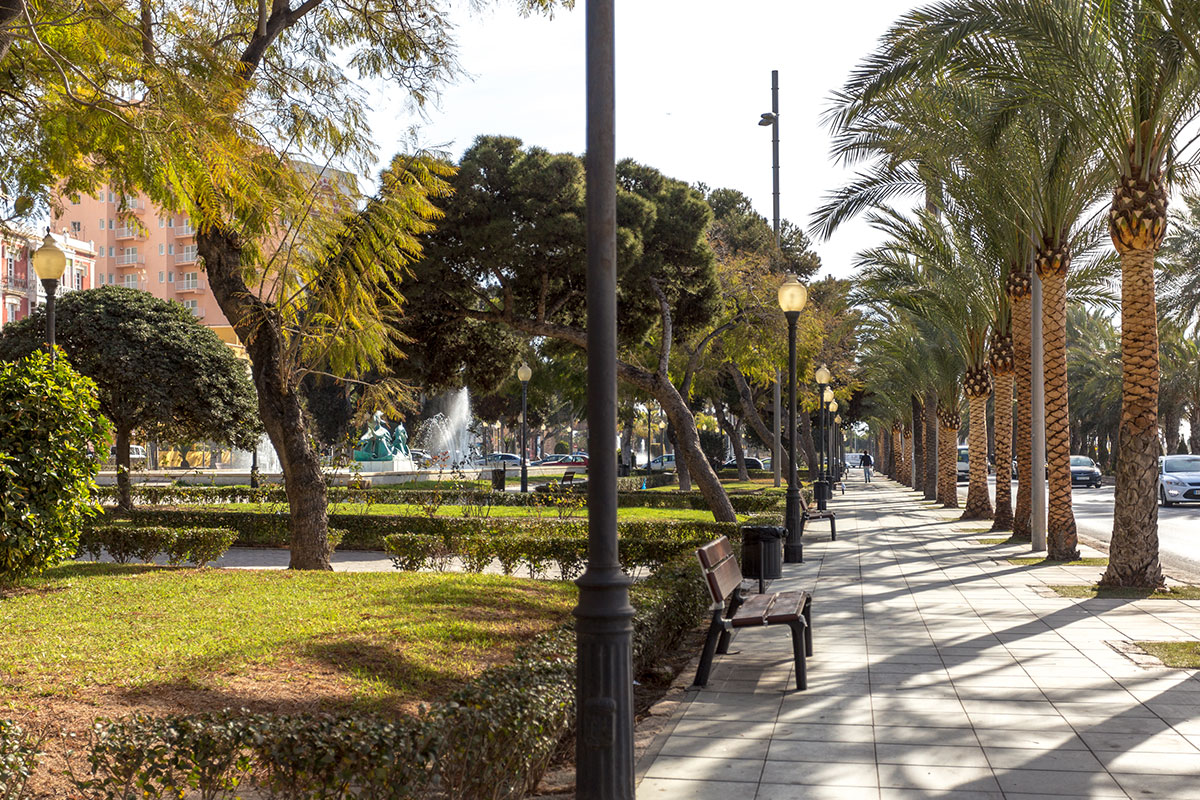
The Port and Nicolas Salmeron Park
Muslim port, so important in the tenth century, no trace. It was from Abderramán III (tenth century) seat of the Caliphate axis fleet and an intense commercial life. Through him, Almería had contacts with the Mediterranean.
In the nineteenth century the construction of the port was a real need and a major enhancements contribution to the enhancement of the capital, laying the first stone pier on May 23, 1847, in what until then was nothing more than a beach open. The need to export uvaprimero, iron ore and then were determining factors in the construction of the port of Almeria.
The needs of smelting lead from Heredia in Pescadería, accelerated the construction of a pier to the west, while the Board of Port Works, try to activate the lift construction dock and the dock that would culminate in 1906. One of the most important products of port traffic was iron ore, hence acquired great importance the mineral carrier or “the English Cable“, a representative example of iron Architecture and mining importance of the nineteenth century.
Currently, the port is divided into three areas: “Pier West” or fishing harbor, the commercial dock where ships dock and the sport dock with the marina and the beach, where is “The Cable English”. It is noteworthy dock lift, where real steps were built with the arrival in our city of Isabel II. From this place a beautiful panoramic sea urban observed.
In the Nicolás Salmerón Park is the Source of Fish, current Plaza de la Marina, which serves as a separation between the Old Park (west) of the nineteenth century and built in 1940, in honor of the President of the First Republic New Park, D. Nicolas Salmeron, born in Alhama (Almería). The park was completely restored in the last years of the twentieth century. In the section dedicated to Nicolas Salmeron are two fountains representing the figure of “Marino” and “Dolphin”. Waterfront Park and Puerto recent urbanization of the Rambla (XX century and early XXI) that gives the city an aspect of modernity stands.
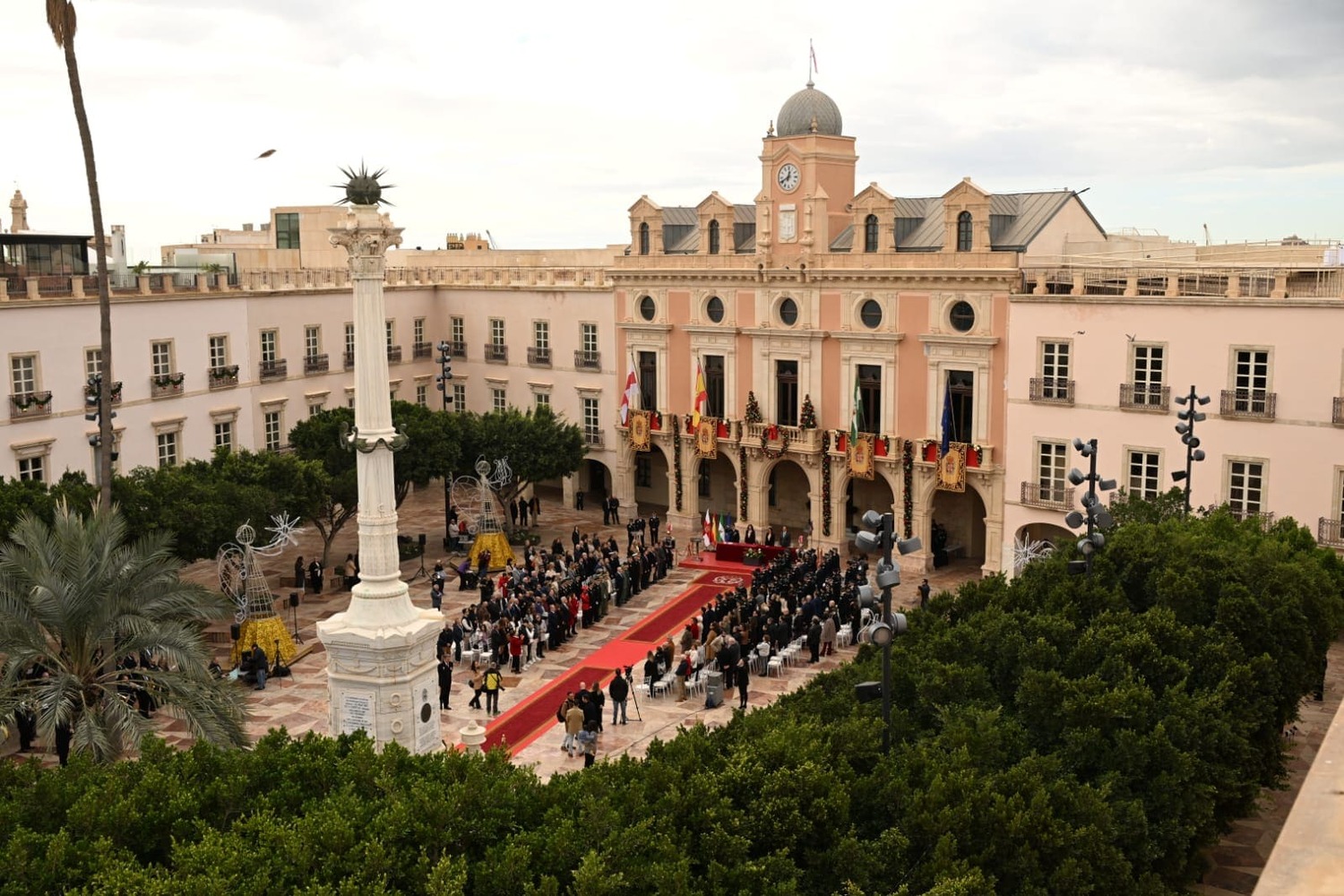
Plaza de la Constitución
Plaza Vieja, is the oldest town square is located in a secluded corner and endearing. It was a place of games, parties and bulls, processions and civic parades.
In Muslim period was an irregular square and was the main souk. With Christians will be known as Square “Game of Reeds.” It will take its final appearance in the mid-nineteenth century, with arcades in the Netherlands and two-storey apartments. This is a place that has a slightly trapezoidal, and maintains the characteristic of the places closed and arcaded nineteenth century.
The square is dominated by the Town Hall, eclectic style, built between the late nineteenth and early twentieth centuries. The facade is divided into three sections. The first houses the arcades with arches, followed by a more developed second body, where balconies are located, and the third where the attic is. In the center of the facade, and at the top, the tower is topped with a dome, where the clock and shield of the City of Almería.
In the center of the square stands “The Monument to the Martyrs of Liberty“, emblematic obelisk, dedicated to 24-liberal people, who came to the beaches of Almeria with redcoats (hence its name), to proclaim liberty and the constitution against the despotism of Fernando VII, being shot on August 24, 1824. This is not the primitive monument, the former dates from 1868-1870 and was on the Plaza de Cádiz (current Puerta de Purchena), and in 1900 he moved to the Plaza Vieja, until its demolition in 1943. the first stone was, and it was rebuilt in 1988 by public subscription, it is marble. It consists of a large basement, on which the column that serves boot the colorful Corinthian capitals, topped by a bronze sphere surrounded with spikes or rays of the sun rises. This characteristic monument is known as “Monument to the Coloraos or Pingurucho”.
The northern part of the facade of the square corresponds Convento of the Claras, rebuilt after the fire suffered in the Spanish Civil War.
The Town Hall clock:
The clock on the facade of City Hall plays the popular tune Fandanguillo Almeria, every quarter hour, playing the full chords every hour.
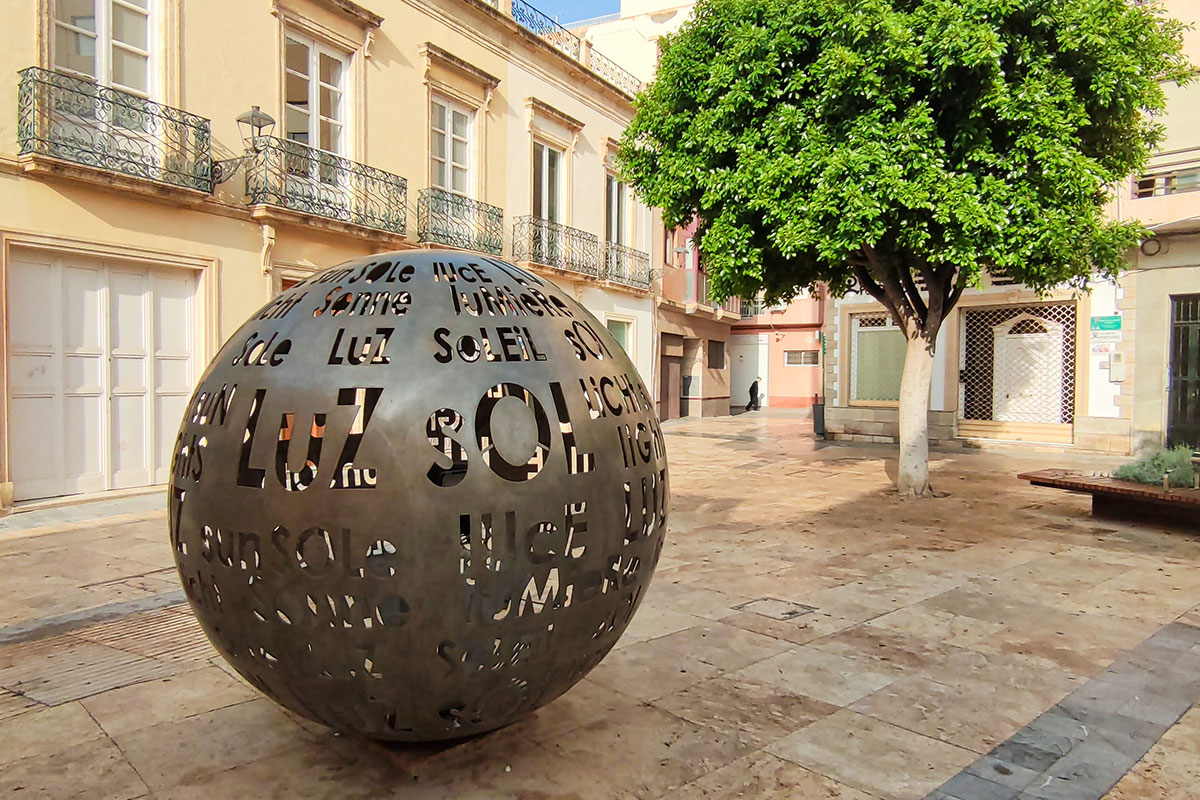
Plaza Careaga
Irregular open spaces within the urban fabric of the old town are numerous, and during the eighteenth and nineteenth centuries will lead to places where the privileged classes of the population are concentrated, as in the case of “La Plaza Careaga”. Its structure inner courtyard inviting spots.
It owes its name to the Family Careaga, who was in this area its solar house. Juan Ochoa Ortiz de Careaga arrived from Vizcaya with four ships to the War of Granada and later went to people in Almeria. D. Miguel Avis-Venegas and Careaga Marín Benavides four illustrious names of 1489 almeriense historical aristocracy blood of Christian conquerors and Muslim princes, the title of Marquis of Torre Alta and Vizconde de Careaga by Carlos II is created. The famous Arch Street is due to bow Careaga, that connected the house of the Marquises with their barns.
In this square it is “The House of the Marquises of Torre Alta”, designed in 1847, and which highlights the composition on two floors. Its structure fits the general type of bourgeois neoclassical housing, finding in it differentiating elements such as pointed arches classicist tradition, innovative in Almeria.

Plaza Bendicho
Located in the heart of Old Town, in the old suburb of La Musalla, it is a secluded square, arising under the Catedral . This space was a favorite as a residence of the aristocracy during the sixteenth to eighteenth places. From the square we can see the cubes and towers of the Cathedral belonging to the ambulatory, where campea the characteristic “Sol de Portocarrero”. The square is dedicated to John F. Juan Leon Bendicho and Quelty, who was born in Malaga in 1809, and after marrying Doña Maria Dolores Puche, settled in Almeria.
In the square is the oldest house in the city “La Casa de los Puche,” eighteenth-century former noble family arrival in Almeria with the first Christian settlers in 1494. It has two floors, the lower, destined to services, and the upper housing owners. In its facade, it emphasizes the cover of stonecutting, framed with columns housing a semicircular arch, on which the family crest rises. The balcony, which rests directly on the cover, has a rich rejería.
Next to the Casa de los Puche, and located on the same line, it is the “House of Music”, the nineteenth century, restored and now houses the Provincial Tourism.
In the center of the square, the bust of the poet “Celia Viñas” who exercised his professional work as a teacher in the capital during the postwar years is enriching the almeriense literary work of the time.
In the last years of the twentieth century, next to the square, the street next to the south wall of the cathedral, Round Beato Diego Advantage, where you can stroll and admire the mighty walls of the fortress Catedral- opened.