



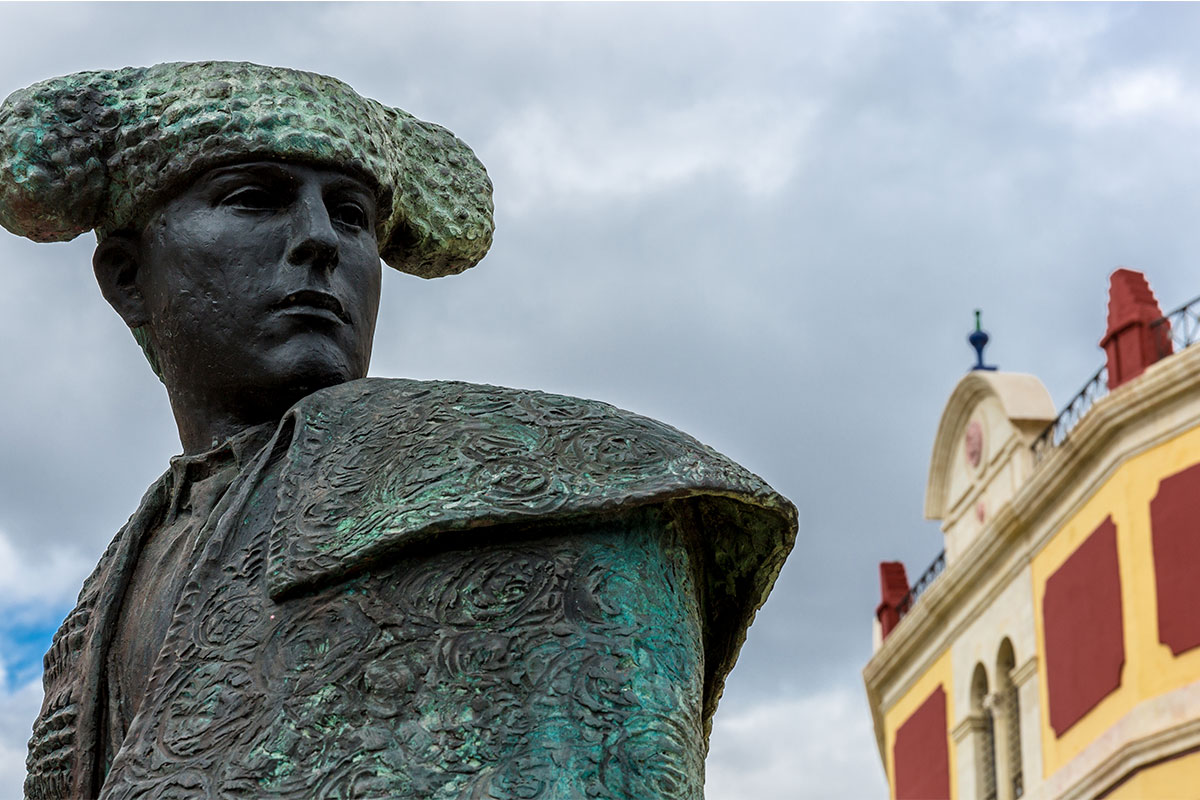
Bull Ring
The old bullring, situated between Murcia, Granada streets (where now stands the “Malecon Jardinillos”) and Circus, near the Rambla, was built in 1849. At the end of the century it became too small and uncomfortable for the needs of the local bourgeoisie, which was increasingly numerous and rich. For this reason, a joint stock company (led by the most representative of the bourgeoisie Almeria), which bought the land for the new square in the “Huerta de los Lopez” at the end of the street Calvary was organized.
The first construction stone was laid on August 13, 1887, celebrated a public ceremony attended by local authorities. The work, led by the two officers architects of the city, Enrique López Rull and Trinidad Cuartara Casinello, completed in July 1888, being the official capacity of 1,054 people Square.
The architecture of the square is eclectic. It consists of a polygonal of twenty sides, three of which are advanced in outgoing bodies, forming Monumental covers access to the entrance of the sun, the principal, and the entry of shade. At the main entrance, there on the keystone of the arch a shield showing the head of a bull with characteristic instruments of the party. In building the Arab influence is seen in the horseshoe arches on the second floor.
Plaza de la Constitución
Plaza Vieja, is the oldest town square is located in a secluded corner and endearing. It was a place of games, parties and bulls, processions and civic parades.
In Muslim period was an irregular square and was the main souk. With Christians will be known as Square “Game of Reeds.” It will take its final appearance in the mid-nineteenth century, with arcades in the Netherlands and two-storey apartments. This is a place that has a slightly trapezoidal, and maintains the characteristic of the places closed and arcaded nineteenth century.
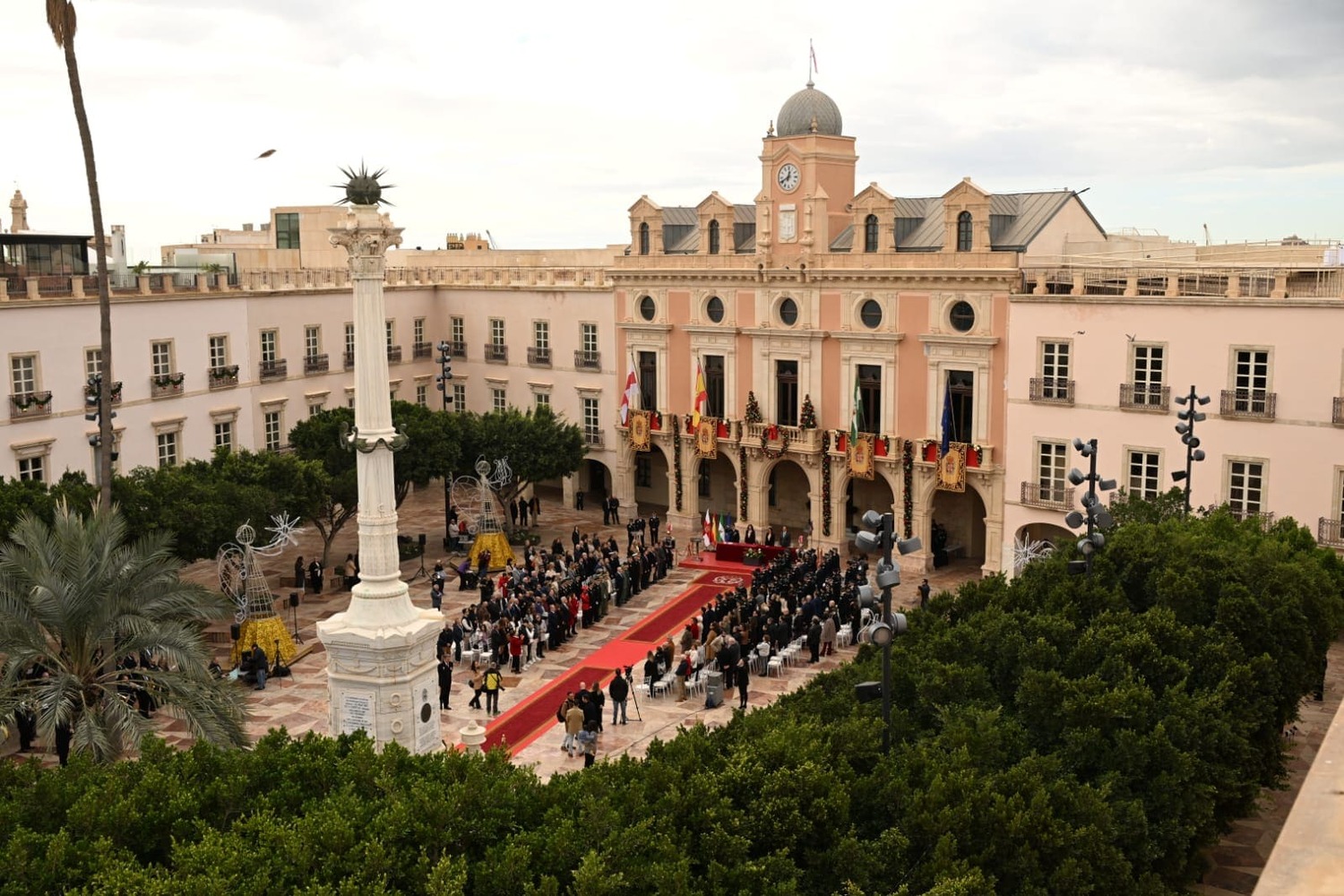
The square is dominated by the Town Hall, eclectic style, built between the late nineteenth and early twentieth centuries. The facade is divided into three sections. The first houses the arcades with arches, followed by a more developed second body, where balconies are located, and the third where the attic is. In the center of the facade, and at the top, the tower is topped with a dome, where the clock and shield of the City of Almería.
In the center of the square stands “The Monument to the Martyrs of Liberty“, emblematic obelisk, dedicated to 24-liberal people, who came to the beaches of Almeria with redcoats (hence its name), to proclaim liberty and the constitution against the despotism of Fernando VII, being shot on August 24, 1824. This is not the primitive monument, the former dates from 1868-1870 and was on the Plaza de Cádiz (current Puerta de Purchena), and in 1900 he moved to the Plaza Vieja, until its demolition in 1943. the first stone was, and it was rebuilt in 1988 by public subscription, it is marble. It consists of a large basement, on which the column that serves boot the colorful Corinthian capitals, topped by a bronze sphere surrounded with spikes or rays of the sun rises. This characteristic monument is known as “Monument to the Coloraos or Pingurucho”.
The northern part of the facade of the square corresponds Convento of the Claras, rebuilt after the fire suffered in the Spanish Civil War.
The Town Hall clock:
The clock on the facade of City Hall plays the popular tune Fandanguillo Almeria, every quarter hour, playing the full chords every hour.
Plaza Careaga
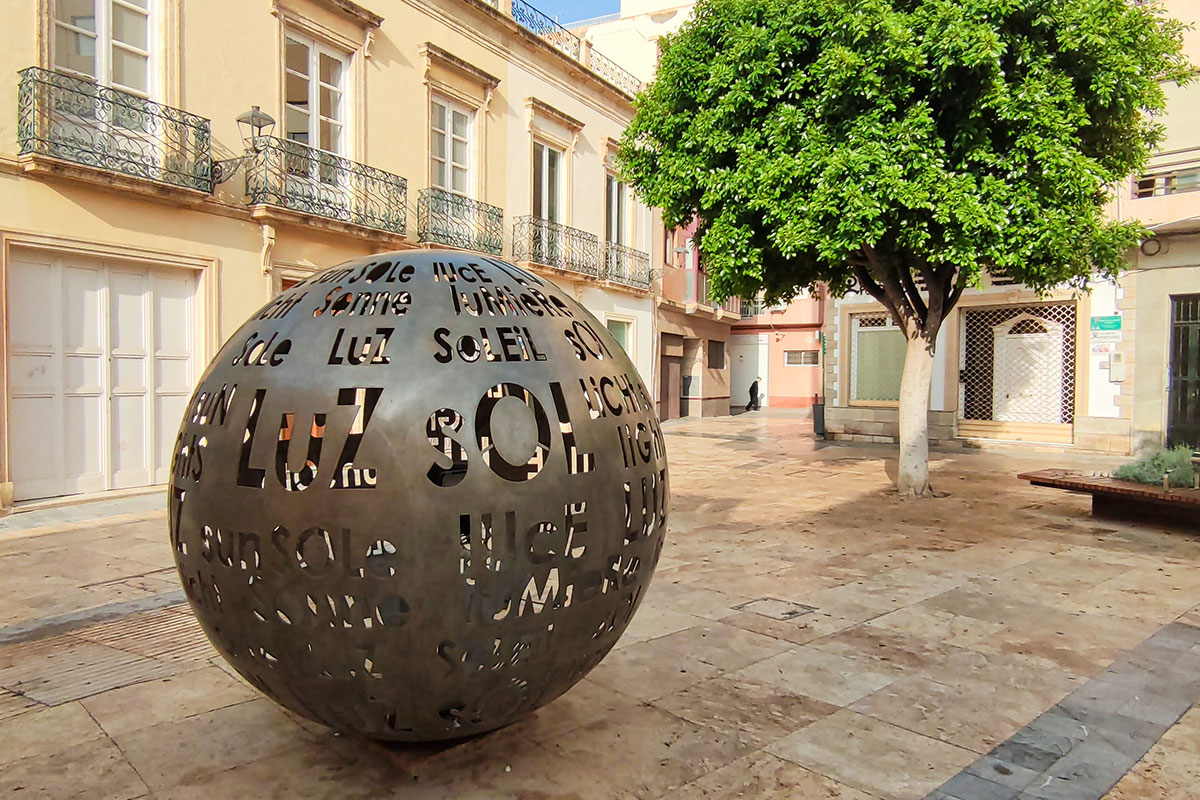
Irregular open spaces within the urban fabric of the old town are numerous, and during the eighteenth and nineteenth centuries will lead to places where the privileged classes of the population are concentrated, as in the case of “La Plaza Careaga”. Its structure inner courtyard inviting spots.
It owes its name to the Family Careaga, who was in this area its solar house. Juan Ochoa Ortiz de Careaga arrived from Vizcaya with four ships to the War of Granada and later went to people in Almeria. D. Miguel Avis-Venegas and Careaga Marín Benavides four illustrious names of 1489 almeriense historical aristocracy blood of Christian conquerors and Muslim princes, the title of Marquis of Torre Alta and Vizconde de Careaga by Carlos II is created. The famous Arch Street is due to bow Careaga, that connected the house of the Marquises with their barns.
In this square it is “The House of the Marquises of Torre Alta”, designed in 1847, and which highlights the composition on two floors. Its structure fits the general type of bourgeois neoclassical housing, finding in it differentiating elements such as pointed arches classicist tradition, innovative in Almeria.

Plaza Bendicho
Located in the heart of Old Town, in the old suburb of La Musalla, it is a secluded square, arising under the Catedral . This space was a favorite as a residence of the aristocracy during the sixteenth to eighteenth places. From the square we can see the cubes and towers of the Cathedral belonging to the ambulatory, where campea the characteristic “Sol de Portocarrero”. The square is dedicated to John F. Juan Leon Bendicho and Quelty, who was born in Malaga in 1809, and after marrying Doña Maria Dolores Puche, settled in Almeria.
In the square is the oldest house in the city “La Casa de los Puche,” eighteenth-century former noble family arrival in Almeria with the first Christian settlers in 1494. It has two floors, the lower, destined to services, and the upper housing owners. In its facade, it emphasizes the cover of stonecutting, framed with columns housing a semicircular arch, on which the family crest rises. The balcony, which rests directly on the cover, has a rich rejería.
Next to the Casa de los Puche, and located on the same line, it is the “House of Music”, the nineteenth century, restored and now houses the Provincial Tourism.
In the center of the square, the bust of the poet “Celia Viñas” who exercised his professional work as a teacher in the capital during the postwar years is enriching the almeriense literary work of the time.
In the last years of the twentieth century, next to the square, the street next to the south wall of the cathedral, Round Beato Diego Advantage, where you can stroll and admire the mighty walls of the fortress Catedral- opened.
Palace of the Viscounts of Castillo de Almansa
The gradual spread of academicians ideas in Spain in the second half of the eighteenth century, will have consequences for the development of housing Almeria. The popular and Baroque features, sometimes closely linked, are to be replaced by an aesthetic intellectualism in architecture predominant feature of the historicist current.
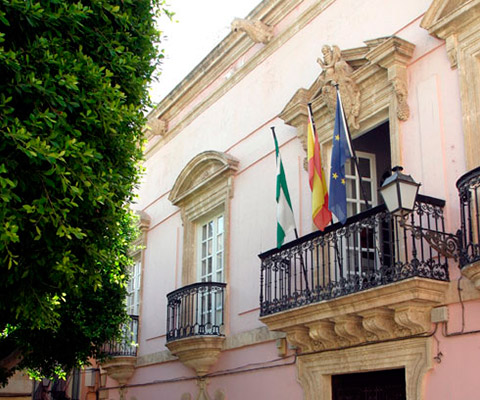
That moment of transition is well defined on the facade of the Palace of the Viscounts of Castillo de Almansa, title created in 1773 for the Almeria family of Almansa.
The palace is one of the most important examples of domestic architecture of the city. The palatial home built between 1773 and 1780 approximately.
The facade, with entablature on top, has two floors: the bottom openings regular distribution houses, and the upper, curved balconies topped by pediments and parties, where the family crest is.
Down the street Infanta you access the Provisional Archaeological Museum, with monumental cover of the “Casa de Don Francisco Jover y Tovar”, designed by the municipal architect Cuartara Casinello Trinidad in 1894.
The whole of the Palace of the Viscounts of Castillo de Almansa, and D. Francisco Jover y Tovar, the mayor and chronicler of Almería, belonging to the current Provincial Historic Archive.
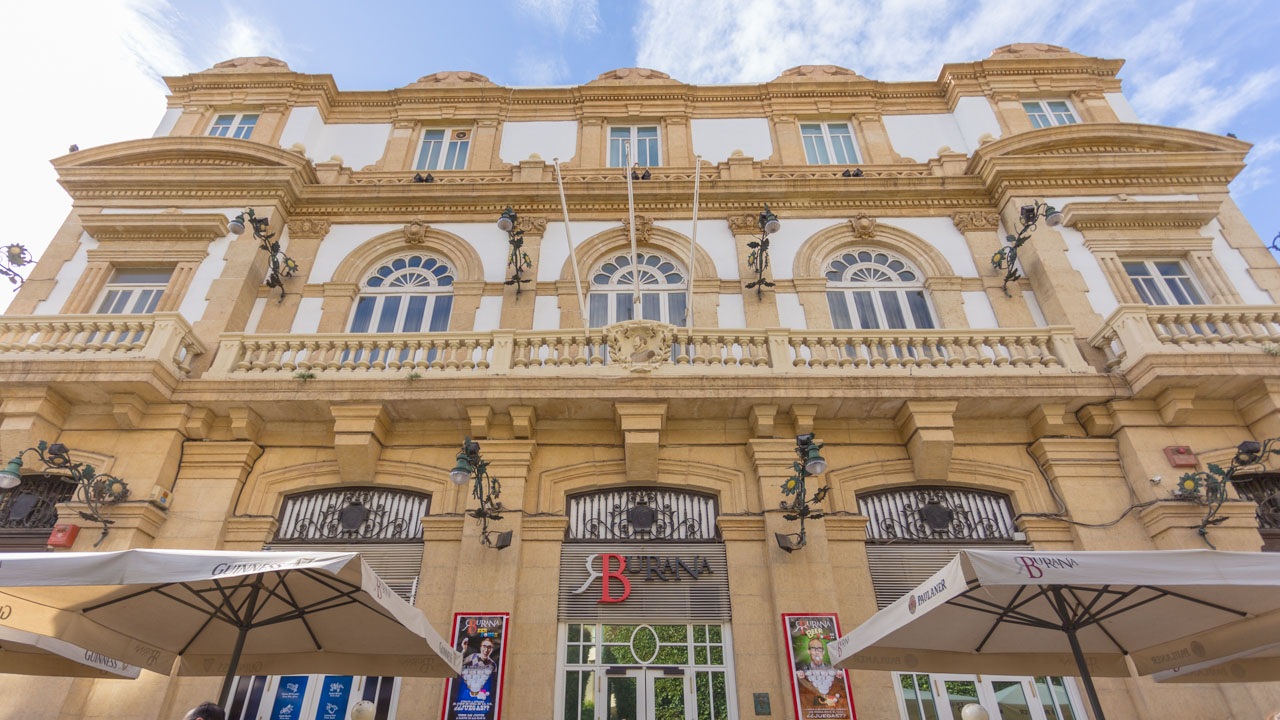
Mercantile Circle and Cervantes Theatre
The Circle, founded between 1887 and 1899, had, together with the Ateneo, based in the Plaza de San Pedro. Subsequently, the two companies are separated. He was president of the company Mr. Ramon Orozco, belonging to an important family that during the second half of the nineteenth century boosted the mining business in Almeria. In 1900 the company opens store in the Paseo del Principe. Later in 1904, the Circle was in a building located again in the Plaza de San Pedro, having its permanent seat on the Paseo, in the building of the Cervantes Theater in the 1920s.
His current halls are home to all kinds of cultural, literary exhibitions and activities, as well as dance and year-end carnival. Its interior decoration is 1920. The Society had a great importance in the economic life of Almeria, interested in the development of the media should give wealth to the city railway, port, mining and agricultural technical improvements.
The construction forms part of the Teatro Cervantes. Specifically, the facade facing the Paseo de Almeria, is from the late nineteenth century and early twentieth century. Monumentalista presents a clear trend: large arches, balustraded balcony with details of a clear naturalism and stylization that approach the modernist trend, highlighting the lamp arms simulating sunflowers. It presents symbolic figurative motifs on its facade that hint at the building’s function: lyres, masks or relief of Cervantes.
Teatro Cervantes was one of the longest running projects of almeriense contemporary architectural period of the late nineteenth century. The start of construction dates back to 1866, coinciding with the requested permission from the construction company to City Hall. After a promising start, the works are stalled until 1898, when the architect Enrique López Rull, makes the plans for the current building. The works will not begin until 1910, and finally, who became the most important theater in the city, opened in 1921.
Address: Paseo de Almeria.
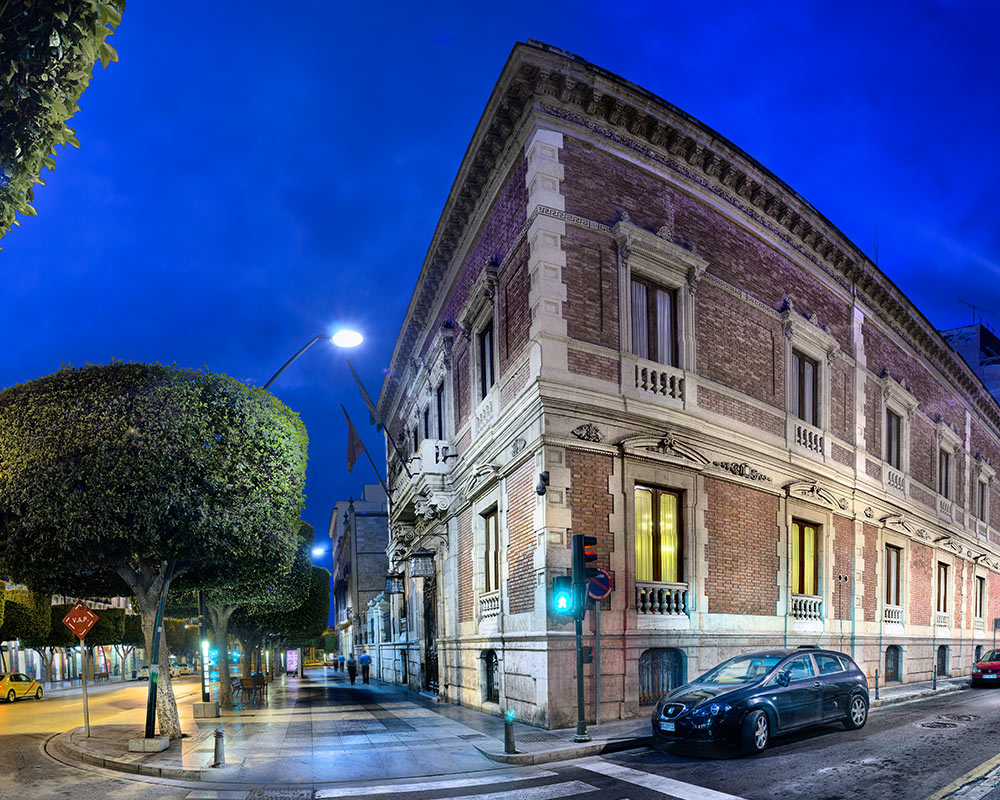
Cultural Casino
Cultural Casino is the current headquarters of the Delegation of the Interior. Originally a palatial house of the Almeria bourgeoisie of the late nineteenth century. Its structure, which follows the historicist models of the time, led to its declaration as a Historical and Artistic Monument in 1982.
The Culture Casino, founded by Joaquin de Vilches in 1840, was definitively taken to El Paseo after considering alternative possibilities. The Culture Casino was established in what was the home of Emilio Perez Ibañez, who had been an important member of the local bourgeoisie in the Restauracion (political period in which the Bourbon Family were again on the Throne 1874-1931). The Project was implemented by Enrique Lopez Rull a very important architect of the time.
Construction, which had several locations in the late nineteenth century and was founded by Joaquin Vilches in 1840, moved permanently in 1905 Paseo, which had been home of Emilio Perez Ibáñez, a leading member of the Almeria bourgeoisie of the period Restoration. It was designed in 1888 by architect Enrique López Rull, very important at the time.
In the 20s of the twentieth century made the building a series of reforms, especially in the ballroom and Muslim ladecoración the “Arab Hall”.
In the Casino had cultural events, it was also a place of social gatherings where the news of the city and related to the situation of the industries and agriculture were discussed local news. It was rather play snooker or chess.
During the Civil War undergoes a partial fire because of the bombing and general neglect. It is renovated in 1940. The building is abandoned between 1950 and 1960, after being acquired by the Government of Andalusia to face the seizure of property.
The facade of the building, which is part of the historicist current, responds to the classic bourgeois model of structure with stone base, which houses the basement, and a monumental doorway crowned with a balcony on the top with classical influences. It has a large hall intended for carriages and artistic staircase railing.
Address: Paseo de Almeria.
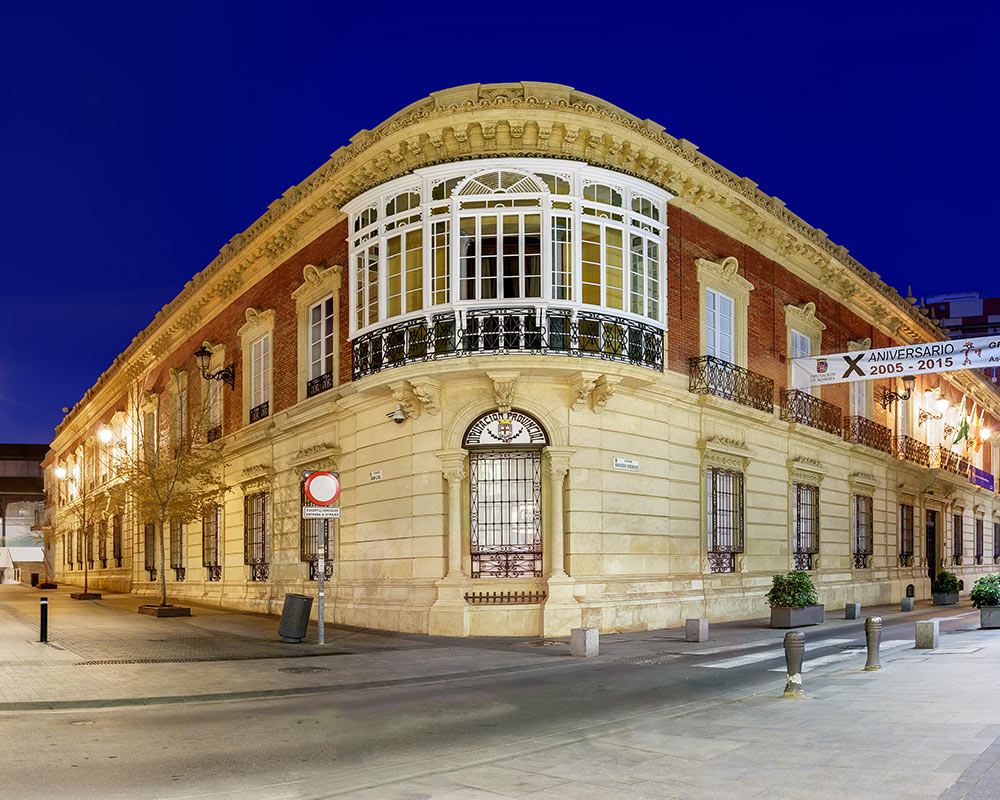
Casa Palacio de Juan Lirola (Council)
The building of the Provincial Government is a house of the bourgeoisie Almeria, known as house-urban palace, located in the former home of Don Juan Lirola, liberal politician of great influence. 1884 enlargement of the architect Trinidad Cuartara Cassinello should. The original project, 1880, occupied the corner of Catholics and Navarro Rodrigo Reyes.
The building, of great importance, consists of two floors. In its facade to the street Reyes Catholics, the body is organized around a stone rustication I run on a high pedestal, and the second body, made with paramento red brick highlight their windows and balconies clear quarried stone-topped moldings that house in the center reliefs of female heads.
In the corner of Calle Navarro Rodrigo Catholic Monarchs with a characteristic ironwork gazebo (where the curved motifs are mixed with geometric) supported by powerful corbels rises.
Inside, it has a magnificent patio lights, host exhibitions and official events. The building style is part of the eclectic current.
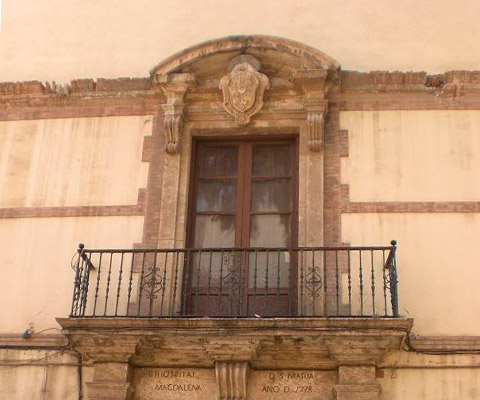
MUREC
The current Provincial Hospital is one of the oldest buildings preserved until today. It is built on the initiative of Bishop Fray Diego Fernandez de Villalán between 1547 and 1557, taking part in the works Juan de Orea. In the late eighteenth century, its administration, until then controlled by the Church, is replaced by a Governing Board composed of ecclesiastical and civil authorities. On the occasion of the creation of this Board in 1777, some major works are carried out in the building. The courtyard, built in the sixteenth century, rebuilt on the occasion of the works undertaken in the Hospital in the late eighteenth century.
The building highlights its main facade on Hospital Street, a neoclassical door built in 1778. This, is framed between two large Ionic pilasters that support an architrave, frieze, and cornice where an inscription with the name of the hospital and the date. The crown topped a balcony in a curved pediment in the centre of the royal coat of arms is housed. The entire set shows a taste academic transition from Baroque to Neoclassicism.
Address: Hospital Street, 04002 Almería
Phone: 619 103 222
Schedule Monuments

Gateway of Purchena
Today, this is a square located in the centre of Almeria city. Pechina Gateway was the most important gateway to the city. But its name was altered after the conquest of the Catholic Monarchs, who mistook Pechina with Purchena. The gateway disappeared after the demolition of the wall in 1855, around the time of the creation of the square. Since the second half of the nineteenth century and early twentieth century with the “boom” of the mining experiment within the province, the square and its surroundings were proliferated by all kinds of bourgeois and palatial houses.
The square was declared a Historic momument in 1991.
This urbanisation is located in the current Plaza Manuel Pérez García and there are numerous points of interest that are accessible from this emblematic square of the city: the Arab Cisterns, the Butterfly House, the Street of Shops and the Refuge of the Civil War and the Nicolas Salmeron statue are some of the points closest to the point of confluence of the city.
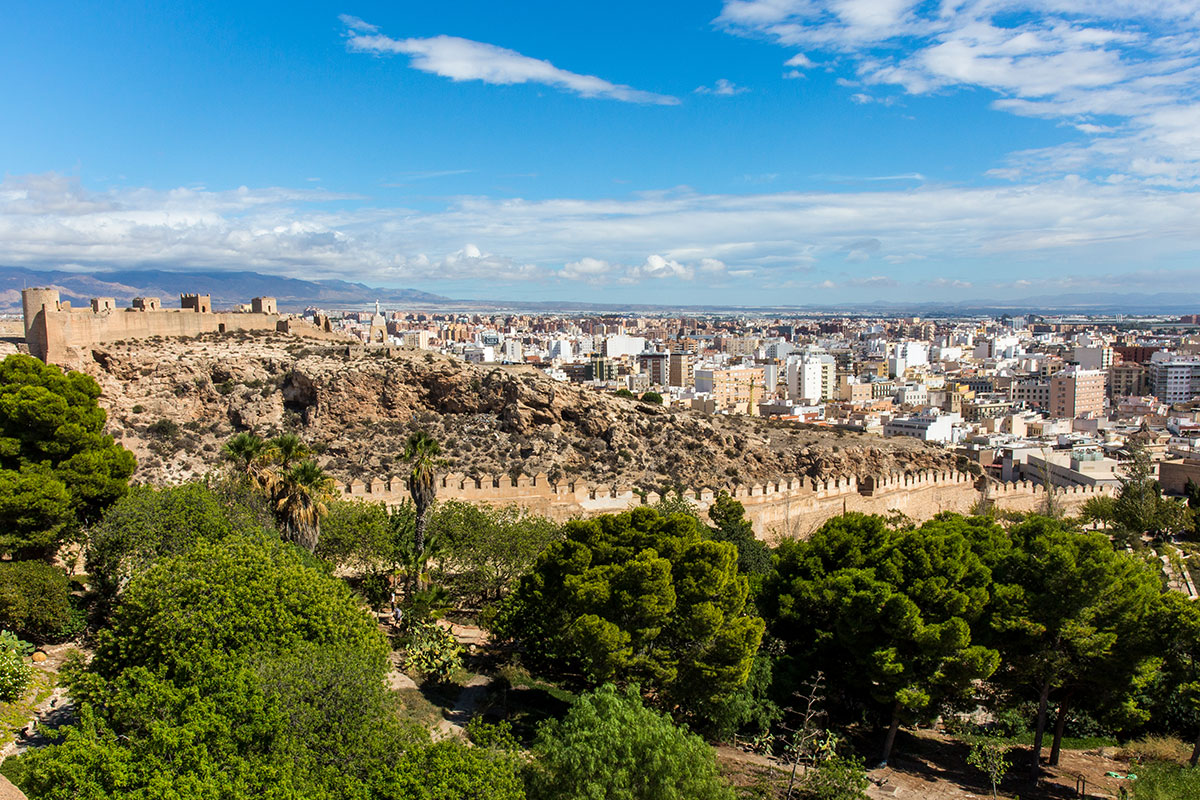
Jayrán Wall and Cerro San Cristobal Hill
From the Alcazaba, descend in a northward direction through the Barranco de la Hoya, a line of wall that reaches San Cristobal Hill, built during the time of King Jairán (1012-1028) in the eleventh century. Here are the remnants of the neighbourhood “amurallamiento musalla”, which descends from the hill via the main street Antonio Vico.
On the hill, known in Muslim times as Monte Laham, there are seven towers, three square Muslim towers and four semicircular Christian towers. These were built by the Templars of Alfonso VII, who constructed a strong-chapel following the Christian conquest of the city under the command of the troops of Alfonso VII in 1147.
On this hill, which has an impressive view of the city, and located on a large pedestal, is the image of the Sacred Heart of Jesus, constructed of local Macael marble. It was restored in 2000 and it is said to bless the city and the Mediterranean Sea. It was originally built in the twentieth century (around 1930).